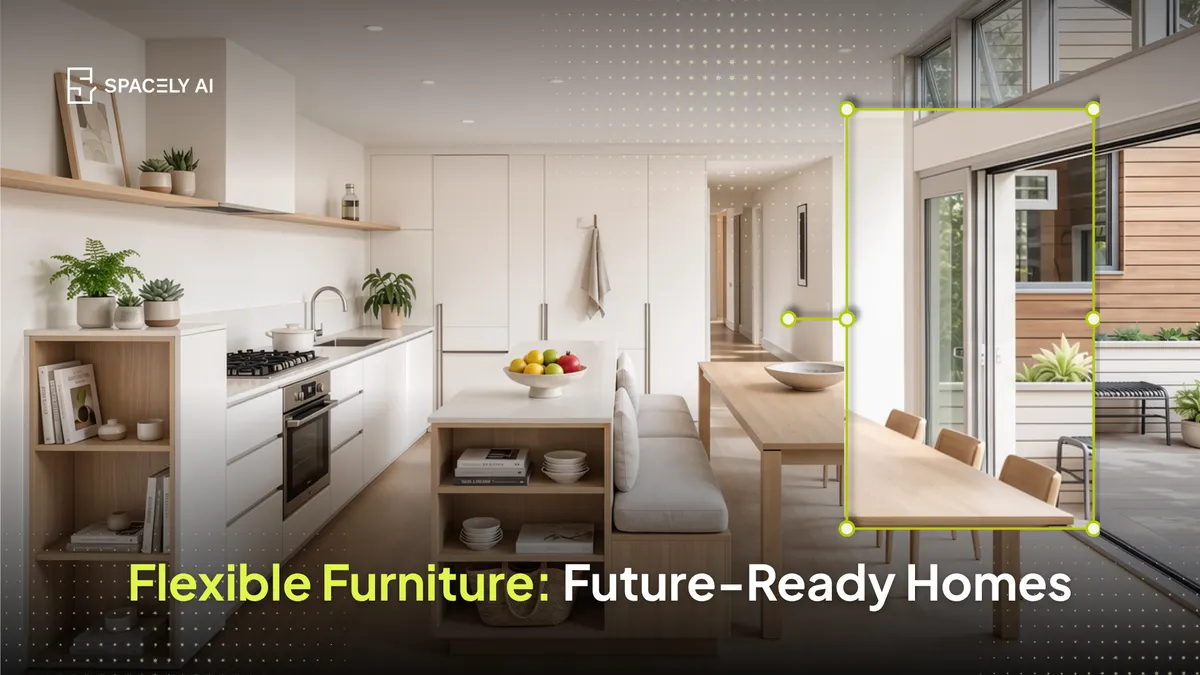
Flexible furniture: modular, multifunctional, adaptable pieces, lets one space do several jobs and change over time. Here's what to choose for a future-ready home.
Flexible furniture is multifunctional, modular, or adaptable pieces such as sofa beds, extendable tables, modular seating, and storage-integrated pieces. It's the backbone of future-ready design: as homes get smaller and life keeps changing — working from home, a growing family, hosting guests — furniture that adapts keeps a space working without a renovation.
Rather than dedicating a whole room to one use, flexible pieces let a living room become a guest room, a dining table shrink for weeknights and expand for dinners, or a modular sofa reshape itself as your needs shift. That's what "future-ready" really means: designing so your home can flex with your life instead of locking you into one layout.
What is flexible furniture?
Furniture that does more than one job or changes as your needs do. Flexible furniture falls into a few overlapping types.
- Multifunctional pieces serve two purposes at once such as a sofa bed, a storage ottoman, a desk that folds away.
- Modular pieces reconfigure: a sectional you can rearrange, shelving you can add to.
- Adaptable pieces adjust to the moment: an extendable table, a nesting set, height-adjustable surfaces.
What unites them is that they let a fixed amount of space stretch to cover more uses, which is exactly what modern homes need as rooms get smaller and lives get busier.
Which flexible furniture pieces are worth it?
The ones that solve a real, recurring need in your space.
| Piece | What it does | Best for |
|---|
| Sofa bed | Living room becomes a guest room | Homes without a spare room |
| Extendable dining table | Small for daily use, large for hosting | Compact dining areas |
| Modular sectional | Reconfigures as needs change | Evolving or open-plan spaces |
| Storage ottoman / bench | Seating plus hidden storage | Small spaces short on storage |
| Fold-away or wall desk | A workspace that disappears | Work-from-home in a shared room |
| Nesting tables | Expand and tuck away as needed | Flexible living and entertaining |
| Storage bed | Sleeping plus significant storage | Bedrooms tight on closet space |
The test for any flexible piece: does it solve a need you actually have more than once? If yes, it earns its place; if it's clever but you'll never use the second function, a simpler piece is better.
Why does flexible furniture matter for future-ready design?
Because a home that can't adapt has to be renovated to keep up. Future-ready design is about building in the ability to change. Households shift when remote work arrives, a family grows, guests come and go, a spare room changes purpose.
A home furnished with fixed, single-use pieces has to be reworked every time life does. A home furnished with flexible pieces just adapts: the office becomes a nursery, the living room hosts overnight guests, the dining table scales to the occasion. Flexible furniture is the most accessible form of future-proofing there is — no construction, no major spend, just pieces that flex. It's especially valuable in smaller homes and apartments, where every room has to earn its keep more than once.
How do you plan a flexible space?
Map the uses, choose pieces that cover more than one, and preview the fit.
- Start by listing everything you need the space to do now and likely soon.
- Then look for pieces that cover more than one of those uses well, prioritizing the overlaps that come up most (a living room that regularly hosts guests clearly wants a good sofa bed).
- Keep circulation clear so the space works in each of its modes, not just one.
Because flexible pieces are often a bigger investment and need to fit precisely in both configurations, preview them in your actual room before buying. Uploading a photo and visualizing the piece in place shows whether the extendable table clears the walkway or the sofa bed fits the wall, before it's delivered.
FAQ
What is flexible furniture? It's multifunctional, modular, or adaptable furniture that lets one space serve several purposes and change over time — sofa beds, extendable tables, modular sectionals, storage-integrated pieces, and fold-away desks. It lets a fixed amount of space stretch to cover more uses, which is ideal for smaller homes and changing needs.
Why is flexible furniture good for future-ready design? Because it lets a home adapt without renovation. As life changes — remote work, a growing family, guests — flexible pieces let rooms shift purpose instead of being reworked. It's the most accessible form of future-proofing: no construction, just pieces that flex with your life.
How do I choose the right flexible furniture? Pick pieces that solve a need you actually have more than once. List what the space needs to do now and soon, choose pieces that cover more than one of those uses well, and keep circulation clear in each mode. Preview the piece on a photo of your room first, since flexible pieces are an investment and need to fit in both configurations.
More design workflow insights on the Spacely AI blog →
Get started
→ Create your free account
→ Watch the full tutorial on YouTube
→ Explore the member plan
For more information and media inquiries, please contact
Website: spacely.ai
Facebook: facebook.com/spacelyai
Instagram: instagram.com/spacely.ai
Email: [email protected]